Your First Pottery Class in Boulder: What to Wear, Learn & Expect
Nervous about your first pottery class? Here's exactly what happens: what to wear, what you'll make, and why 4 weeks beats a one-time workshop.
You signed up for a pottery class. Maybe you've been thinking about it for months. Maybe someone gifted it to you. Maybe you just saw a wheel throwing video at 2 a.m. and thought, I need to try that. Whatever brought you here, welcome. You're going to love it.
Here's everything you need to know before walking into your first pottery class in Boulder.
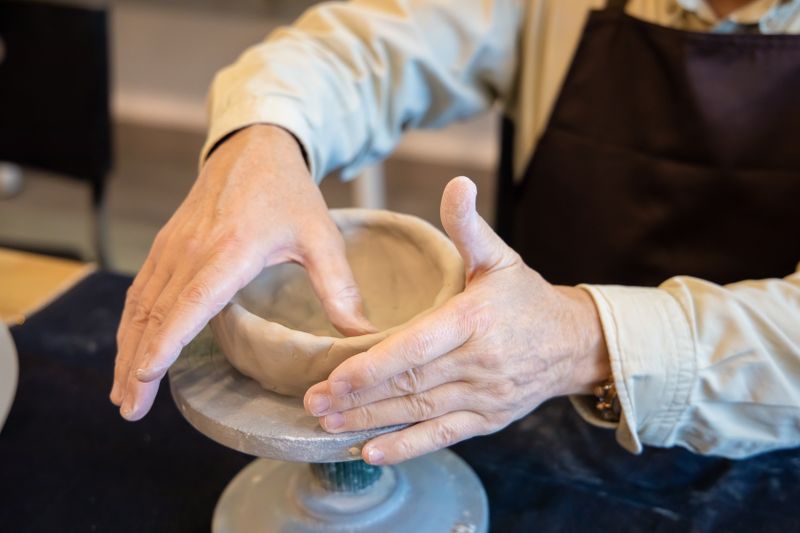
What to Wear
Pottery is messy in the best possible way. Clay gets on your hands, your arms, and inevitably, your clothes. Here's what works:
- Comfortable clothes you don't mind getting dirty. Old jeans, leggings, a t-shirt — nothing precious. Clay washes out of most fabrics, but some stains linger.
- Short or rolled-up sleeves. You'll be working with wet clay up to your elbows, especially on the wheel.
- Closed-toe shoes. Studio floors can be slippery, and you don't want clay between your toes.
- Skip the rings and bracelets. They get in the way of centering clay and can scratch your work. Leave jewelry at home or in your bag.
- Tie back long hair. You will, at some point, push hair off your face with clay-covered hands. It's a rite of passage, but a hair tie helps.
Most studios provide aprons, but if you have a favorite one, bring it along. Boulder Pottery Studio will have aprons available for every student.
What You'll Actually Learn
First-class jitters are real. You might be imagining a Ghost-movie scenario where everything looks effortless. Real pottery is different — and more fun.
If You're Taking a Wheel Throwing Class
You'll start by learning to center clay on the wheel. This is the foundation of everything in wheel throwing, and honestly, it's the hardest part. Your instructor will demonstrate, then guide your hands until you feel the clay go still under your palms. It's a physical, satisfying feeling — you'll know when it clicks.
From there, you'll learn to open the clay (pressing your thumb into the center to create a hollow) and pull walls (drawing the clay upward to create height). By the end of your first session, most students have made a small bowl or cylinder. It won't be perfect. It will be yours, and that's better.
If You're Taking a Handbuilding Class
Handbuilding means working with clay using your hands and simple tools — no wheel required. You'll learn pinch, coil, and slab techniques. Pinch pots are made by pressing and shaping a ball of clay with your thumbs. Coil building stacks ropes of clay to create walls. Slab building uses flat sheets of clay assembled into forms.
Handbuilding is wonderfully forgiving and endlessly creative. There's no centering to master, no spinning wheel to negotiate. Just you and the clay.
Our 4-Week Class Format
At Boulder Pottery Studio, our beginner classes run for four weeks. Here's why that matters: pottery isn't a one-session craft. The four-week format gives you time to practice, improve, and actually finish pieces — including glazing and firing.
A typical progression looks like this:
- Weeks 1-2: Fundamentals. Centering, basic forms, getting comfortable with clay.
- Weeks 3-4: Building skills. Larger forms, better control, trimming your work.
- Weeks 5-6: Glazing and finishing. Choose glazes, learn application techniques, fire your pieces in the kiln.
By the end, you'll take home pottery you made from start to finish. Real, functional, food-safe pottery.
Do I Need Any Experience?
None. Zero. Our beginner classes assume you've never touched clay. We start from scratch and build up. Every single person in the class is learning, and our instructors are patient, encouraging, and genuinely excited to teach. The studio is small — 10 students max per class — so you'll get real attention and hands-on help.
You don't need to be "artistic" or "creative" to enjoy pottery. You just need to be willing to get your hands dirty and laugh when things wobble off-center. That's the whole deal.
What Happens After Class
After you've shaped your piece, it needs to dry slowly. Once it's leather-hard, we trim the bottom and refine the shape. After it's fully dry, it goes into the kiln for a bisque firing — the first firing that hardens the clay. Then you glaze it, and it goes back in the kiln for a glaze firing that melts the glaze into a glass-like surface.
The whole process takes a few weeks. It teaches patience, which is secretly one of pottery's best gifts.
Ready to Try It?
Boulder Pottery Studio is opening in Spring 2027 with beginner pottery classes, open studio memberships, and a welcoming space for everyone. No experience required. Just curiosity and a willingness to get a little clay on your shirt.
Join our waitlist to get early access to classes and founding member pricing.
Explore More
Join the Boulder Pottery Community
Sign up for early access to classes, workshops, and founding member pricing.
Get NotifiedGet on the List
We open in East Boulder in Spring 2027. 80+ people are already on the list. First class seats and founding rates go to the list first.